


Best Fleet Washing Services for Your Business

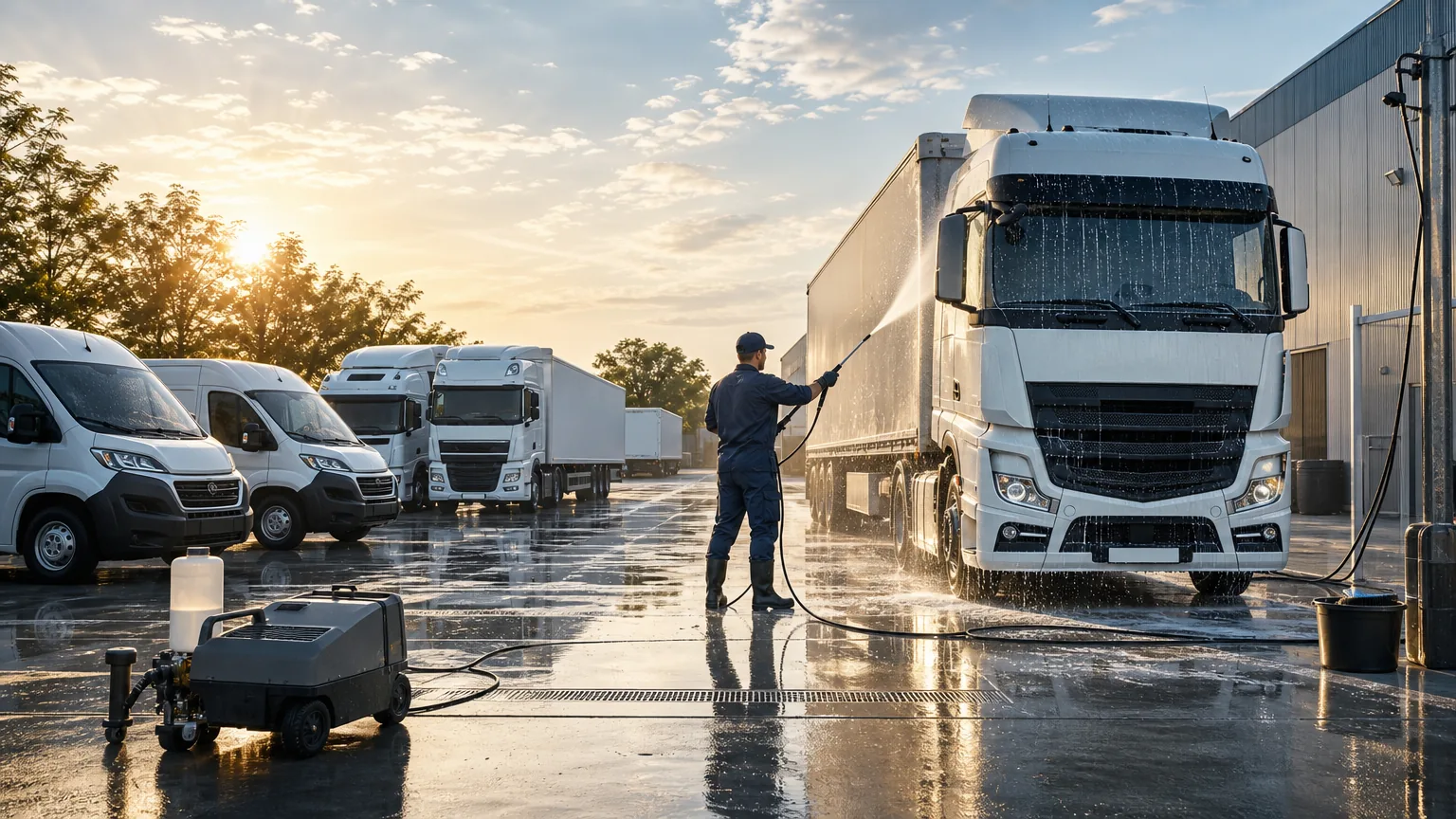
A dirty fleet costs you more than you think. Grime builds up fast on trucks running Florida roads, and once road salt, diesel exhaust, and mud bake onto metal, a garden hose won't touch it. Here are eight fleet washing options, typed by service model, so you can find the right fit whether you run three delivery vans or 300 over-the-road rigs.
Table of Contents
1. Performance Pressure Wash — Our Top Pick for Central Florida Fleet Washing
2. Mobile On-Site Fleet Washing Services — Convenience for Large Fleets
3. Two-Step Chemical Fleet Washing Systems — Best for Heavy Grease and Road Grime
4. High-Heat Pressure Washing for Trucks — Best for Baked-On Grease and Engine Grime
5. Eco-Friendly Fleet Washing Services — Best for Regulatory Compliance
6. Scheduled Fleet Washing Contracts — Best for Ongoing Maintenance Programs
7. Heavy Equipment and Construction Fleet Washing — Best for Job Site Vehicles
8. Food Truck and Specialty Vehicle Washing — Best for Restaurant and Catering Fleets
1. Performance Pressure Wash — Our Top Pick for Central Florida Fleet Washing
Performance Pressure Wash is a licensed and insured family-owned exterior cleaning company serving businesses throughout Central Florida. We specialize in fleet washing for trucks, trailers, delivery vans, box trucks, and specialty vehicles , and we come to your yard so your drivers never have to leave the route.
What sets us apart in this market is equipment. We run hot-water systems because heat is what actually breaks the bond between baked-on grease and painted metal. Low pressure with cold water can knock off loose dirt, but it won't touch diesel residue or engine oil that has been sitting on a cab for weeks. Our hot-water rigs combined with the right degreaser chemistry do that work without damaging decals, polished aluminum, or painted surfaces.
We handle the full scope of Central Florida fleet types. Contractors running excavators and dump trucks, logistics companies with refrigerated trailers, retailers with delivery vans, and food-service operators all have different cleaning needs. We adjust method and chemistry to match the vehicle type. For food transport fleets, hot water also helps sanitize contact surfaces, which matters for FSMA compliance.
Our fleet cleaning services in Orlando cover Orlando, Kissimmee, Lake Mary, Saint Cloud, Winter Park, Apopka, and surrounding Central Florida areas. We offer scheduled contract pricing so fleet managers can budget cleanings the same way they budget oil changes. Same-day service is available for urgent situations.
The one limitation worth naming: we're a Central Florida operation. If your fleet runs out of state depots, we can't serve those locations. For businesses headquartered locally with vehicles that return to a Central Florida yard, we're the call to make first.
2. Mobile On-Site Fleet Washing Services — Convenience for Large Fleets
Mobile on-site fleet washing means the crew and equipment come to wherever your trucks park , your lot, a terminal, or a remote job site. No driver time lost. No fuel burned hauling equipment to a fixed wash bay.
This model works especially well for fleets with 15 or more vehicles. At that scale, sending trucks one at a time to a commercial wash bay eats hours of productive driver time each week. A mobile crew sets up at your location and runs through the yard while drivers are loading, fueling, or on a break. The process becomes clockwork: drivers pull in from their routes, get washed, and roll out , the whole side of a sleeper cab cleaned quickly with a dialed-in two-step chemical system.
Water logistics are the main planning challenge for mobile services. Most providers need a water source on-site: a hose bib, a standpipe, or a facility tap. For remote sites, they bring a buffer tank , typically 300 to 500 gallons on a trailer , but that limits how many trucks they can clean before needing to refill. If your yard has water available, that constraint disappears.
For Central Florida businesses, our commercial pressure washing services already include mobile deployment as standard. Pricing for mobile contracts depends on fleet size, vehicle type, and cleaning frequency. Larger accounts typically negotiate a per-truck rate that drops as volume goes up.
One real caveat: wastewater runoff. Local and state regulations govern where wash water can drain. Florida's stormwater rules mean that washing in a lot where runoff flows untreated into a storm drain can trigger fines for the property owner. A good mobile provider either uses a recovery system or washes in a designated bay with a drain. Always ask about wastewater handling before signing a contract.
3. Two-Step Chemical Fleet Washing Systems — Best for Heavy Grease and Road Grime
The two-step system is the industry standard for over-the-road trucks and trailers that accumulate road film fast. Step one is a low-pH acid solution that breaks the electrostatic bond holding dirt and oxidation to metal surfaces, and it brightens aluminum at the same time. Step two is a high-pH alkaline soap that attacks grease and organic grime. Rinse it off and the truck comes out clean without ever touching it with a brush , if the chemicals are dialed in correctly.
The chemistry explanation matters here. That aluminum strip along the lower side of a trailer starts reddish-brown from road oxidation. After a proper acid step, it comes back bright white. No scrubbing required. The key is applying each step and letting the chemistry work before rinsing, not blasting with high pressure.
For trucks that have never been two-stepped, or that were washed with a different chemical system, a brush pass after the first wash helps loosen built-up residue. After that initial season, regular two-step visits maintain the surface the way seasoning maintains a cast-iron pan , each subsequent wash gets easier because the soap chemistry builds on the prior clean.
Chemical pre-treatment is widely used in commercial vehicle cleaning because it reduces the mechanical force needed to remove contamination, lowering the risk of surface damage. That's exactly why two-step is the right call for painted trailers with decals or polished aluminum tanks.
Services offering a true two-step system should be able to tell you the pH range of each product and explain why they chose that chemistry for your vehicle type. If a provider just shows up with a single soap and a pressure washer, that's not a two-step system , it's a rinse with foam, and it won't get the same result.
4. High-Heat Pressure Washing for Trucks — Best for Baked-On Grease and Engine Grime
Cold water pressure washing won't cut it for engine compartments, undercarriages, or any surface where petroleum grease has been baking in Florida heat for months. High-heat systems run water at 180°F to 250°F, and that temperature does most of the chemical work. Think of it this way: the same reason you use hot water to wash a greasy pan is the reason hot water outperforms cold water on a diesel engine bay.
The right process combines heat with a quality degreaser applied at the right dwell time. The degreaser penetrates the grease layer while the hot water carries it away on the rinse. Cold water with the same degreaser leaves residue behind because the grease never fully liquefies. This is a content rule we hold to: low-pressure cold methods don't remove stubborn baked-on grease. It's our high-heat water system with the right degreaser chemistry that does the actual work.
Engine bays on semi-trucks are a different animal from trailer exteriors. The surfaces are tight, there are electrical components to protect, and the grease is often compounded with road salt and debris that has been heat-welded over thousands of miles. A technician who knows where to direct heat and where to keep pressure low can clean an engine bay without damaging sensors or wiring uses. That skill comes from experience, not just equipment.
Pro Tip:Ask any fleet washing provider whether their equipment runs a true heat exchanger or just a hot-water tank. A heat exchanger maintains consistent temperature at the gun through long hose runs , a tank system loses heat fast. For engine bay work, consistent heat matters.
High-heat service typically costs more per vehicle than a standard two-step wash, and it should. The equipment investment is higher, diesel fuel consumption is real (hot-water units run diesel burners), and the labor is more demanding. For fleets where engine cleanliness affects warranty coverage or DOT inspection outcomes, it's worth the difference.
5. Eco-Friendly Fleet Washing Services — Best for Regulatory Compliance
Environmental compliance is not optional in commercial fleet washing. Florida stormwater regulations prohibit untreated wash water from entering storm drains. A business that hires a low-cost wash crew with no wastewater plan can end up holding the liability for an illegal discharge on their property.
Eco-friendly fleet washing services address this with a combination of low-toxicity biodegradable detergents, water-reclaim systems or directed drainage to sanitary sewer connections, and reduced water volume from chemical pre-treatment rather than volume-based rinsing. Some operations use surface berms and vacuum recovery rigs to capture all runoff on-site.
Biodegradable detergent formulations have improved significantly. Today's phosphate-free, pH-neutral soaps clean effectively on light road film without the environmental load of older caustic chemistry. For fleets with a strong environmental or ESG reporting commitment, switching to a certified eco-friendly wash program is a documentable step.
The usable limitation is cost. Water recovery equipment and compliant disposal add overhead to any service contract. Eco-compliant providers typically price their services higher than a basic wash crew. The trade-off is that you're not exposed to a fine from a state agency or a municipality complaint about runoff from your property.
For businesses in Central Florida that operate near retention ponds or wetland buffers , common in this region's geography , eco-friendly wash protocols aren't just a preference. They're a usable risk management decision.
6. Scheduled Fleet Washing Contracts — Best for Ongoing Maintenance Programs
A one-time fleet wash handles an immediate problem. A scheduled contract prevents the problem from building up in the first place. For businesses where vehicle appearance directly affects customer perception , delivery companies, utility fleets, branded vans , a regular wash schedule keeps the fleet at a consistent standard rather than cycling between filthy and clean.
Contract pricing structures vary, but most providers offer three common models: a flat monthly fee for a set number of vehicles, a per-truck rate billed after each visit, or an annual contract with a fixed weekly or bi-weekly schedule. The flat monthly model works well for stable fleets. The per-truck model suits fleets where vehicle count fluctuates with seasonal work.
Large-scale fleet washing contracts built on weekly service at multiple locations represent a significant business relationship for both parties. Cost considerations typically include labor, chemicals, equipment depreciation, and fuel for hot-water equipment and travel. Providers who price accurately upfront rather than undercutting to win the bid are better positioned to deliver consistent quality throughout the contract term. A well-run service contract at that volume is a real business relationship, not a commodity transaction.
Key Takeaway:When comparing contract bids, ask providers to break down their cost structure. A provider who can explain their chemical, labor, and equipment costs is one who understands the work , and one less likely to cut corners six months into the contract.
For fleet managers, scheduling regular washes also extends vehicle life. Road salt, bird droppings, and diesel exhaust are mildly corrosive over time. In Florida's humidity and heat, biological growth like mold and algae can take hold on trailer sidewalls and wheel wells within weeks. Regular washing removes those agents before they pit or stain surfaces. Think of it the same way you think about oil changes: deferred maintenance always costs more in the long run.
7. Heavy Equipment and Construction Fleet Washing — Best for Job Site Vehicles
Excavators, bulldozers, skid steers, and haul trucks are in a different category from semi-trucks. Tracked vehicles especially trap mud in every crevice, and the clay soil common around Central Florida construction sites packs harder than road grime. Washing heavy equipment before it moves to a new site or before a rental return is often a DOT or rental-company requirement.
Pulling a mud-covered excavator down the highway on a lowboy puts the transport company at risk of DOT fines if debris falls off and strikes a vehicle. That creates a clear business case for a wash before every move, with the ROI straightforward compared to the cost of a DOT citation or a rental penalty.
Water logistics are the core challenge here. Construction sites rarely have an accessible water source near where the equipment sits. A service provider who brings their own buffer tank , typically 300 to 500 gallons on a trailer , can handle a few pieces of equipment remotely. For larger jobs, a water truck or coordination with the site's on-site water supply is necessary.
This is also a service category where the work doesn't need to be a detail. The goal is removing heavy mud and debris, not showroom polish. A skilled operator with a long-barreled 48-inch gun, eye protection, and appropriate PPE can knock the heavy material off a tracked vehicle in 20 minutes without crawling underneath it. PPE matters here more than most people expect , pressure at close range on caked mud can send debris back at speed.
For Orlando-area contractors, folding equipment washing into a broader commercial fleet and facility maintenance program is often more cost-effective than calling for one-off service every time a piece of equipment needs to move.
8. Food Truck and Specialty Vehicle Washing — Best for Restaurant and Catering Fleets
Food trucks live in a different regulatory environment from freight fleets. The exterior needs to look clean for customer confidence and for health inspections, but the cleaning chemistry also has to be safe near food-contact surfaces. Caustic degreasers that work well on a diesel tank are not appropriate near a service window or a prep area exterior.
A good food truck washing service uses food-safe degreaser formulations on the cooking exterior and hood areas, and adjusts pressure near wrap graphics or custom paint , high pressure too close to a vinyl wrap tears edges and lifts seams. Hot water is still effective here; it just requires the right application distance and a technician who knows where each surface type starts and stops.
For catering companies running multiple vehicles, a scheduled washing contract keeps the entire fleet consistent. One truck that looks clean while another shows grease streaks sends the wrong message to an event client before the food even comes out. The same logic applies to any branded vehicle fleet: consistency across the fleet is more valuable than a single perfect wash.
Our food truck cleaning service at Performance Pressure Wash is built specifically for this need , exterior washing with chemistry appropriate for food service environments, done at your location on a schedule that fits your operating calendar. We also handle kitchen equipment exterior degreasing for trucks that need a more thorough service before a health inspection.
The limitation worth noting: interior kitchen equipment cleaning is a different service from exterior washing. If a food truck needs interior hood and duct cleaning, that falls under commercial kitchen hood cleaning , a separate specialty with its own safety and fire code requirements.
What to Look for When Choosing a Fleet Washing Service
The right fleet washing service depends on four things: your vehicle type, your volume, your site constraints, and your compliance exposure. Here's a quick decision grid.
Factor | What to Ask | Why It Matters |
Equipment | Do they run hot water or cold? | Hot water is necessary for baked-on grease and engine grime |
Chemistry | Two-step system or single soap? | Two-step produces a cleaner result on road film and aluminum |
Wastewater | How do they handle runoff? | Improper discharge can put liability on your property |
Licensing | Are they licensed and insured? | Protects you if equipment or a vehicle is damaged during service |
Scheduling | Can they commit to a fixed schedule? | Consistency prevents buildup and keeps fleet appearance stable |
Pricing model | Per truck, flat monthly, or annual contract? | Match the model to your fleet size and seasonal variation |
Vehicle type experience | Have they washed your specific vehicle types before? | Food trucks, heavy equipment, and over-the-road rigs each need different technique |
License and insurance aren't a formality. If a wash crew damages a truck's decals, paint, or sensors while on your property, you need to know their liability coverage stands behind the work. A verbal assurance isn't enough , ask for a certificate of insurance before scheduling a first visit.
On pricing: the lowest bid rarely holds up over a full contract year. Providers who underestimate chemical and labor costs either cut corners on product quality or quietly reduce visit frequency. Ask any provider to walk through their cost structure before you sign. That conversation tells you a lot about whether they've actually done the math. You can also request a free estimate from our team to benchmark what a properly scoped Central Florida contract looks like.
Frequently Asked Questions
How often should a commercial fleet be washed?
Most over-the-road trucks and delivery vans benefit from washing every one to two weeks. Heavy equipment used on muddy job sites may need washing before every move. For branded or customer-facing vehicles, a bi-weekly schedule keeps appearance consistent. In Central Florida's humidity, algae and mold can start building on trailer sidewalls within two to three weeks of the last wash, so waiting longer than a month between services usually means heavier buildup to remove.
What's the difference between a two-step fleet wash and a standard wash?
A two-step fleet wash uses a low-pH acid solution first to break down road oxidation and brighten aluminum, then a high-pH alkaline soap to lift grease and grime. A standard wash uses a single soap and water. The two-step system produces a noticeably cleaner result on trucks that accumulate road film , especially on polished aluminum surfaces , without requiring brush scrubbing on every visit.
Is fleet washing required for DOT compliance?
DOT doesn't mandate a specific wash schedule, but vehicles hauling regulated cargo, operating in states with anti-mud-flap laws, or returning rental equipment often face usable cleaning requirements. Some contracts and terminal policies also require clean vehicles. Beyond compliance, visible equipment condition affects DOT inspection outcomes and can influence roadside enforcement attention. Regular fleet washing supports a professional maintenance record.
Can fleet washing damage paint or decals on trucks?
It can, if done incorrectly. High-pressure direct contact on vinyl wraps or decal edges lifts adhesive over time. Caustic chemistry not matched to the surface can dull paint. A professional service adjusts pressure, standoff distance, and chemistry to the vehicle type. Hot water with the right degreaser removes grease without the mechanical force that damages graphics. Always ask a provider about their approach before they touch a wrapped or recently painted vehicle.
How much does fleet washing cost per truck?
Pricing varies widely by vehicle type, cleaning method, and contract volume. A basic rinse-and-soap wash on a delivery van costs less than a full two-step hot-water service on a semi-truck. Larger fleets typically negotiate a lower per-unit rate. The best way to get an accurate number is to describe your fleet size and vehicle types to a local provider and ask for a quoted contract rate.
Do I need to provide water for a mobile fleet washing service?
Most mobile providers prefer to use a water source at your location because it removes the tank-refill constraint. A facility tap or standpipe is usually sufficient. If your site has no water access, providers can bring a buffer tank, typically 300 to 500 gallons, which limits how many vehicles they can clean per trip. For large fleet accounts, coordinating on-site water access before the first visit makes the whole operation run faster.
Conclusion
For Central Florida businesses, Performance Pressure Wash is our clear first recommendation: licensed, insured, mobile, and equipped with hot-water systems that handle everything from food trucks to over-the-road rigs. If you're ready to set up a scheduled contract or need a one-time service, reach out through our website for a free, no-obligation estimate , most requests get a response within 24 hours.


Comments